
Buyer's glossary · 8 min read
Shower pan vs shower base: what the words mean when you are buying a kit
Retailers use pan and base as if they were the same thing. Tile setters do not. Plumbing codes use a third word entirely. If you know which product someone is actually talking about, you can compare prices honestly and avoid buying the wrong floor for your shower.
The short version
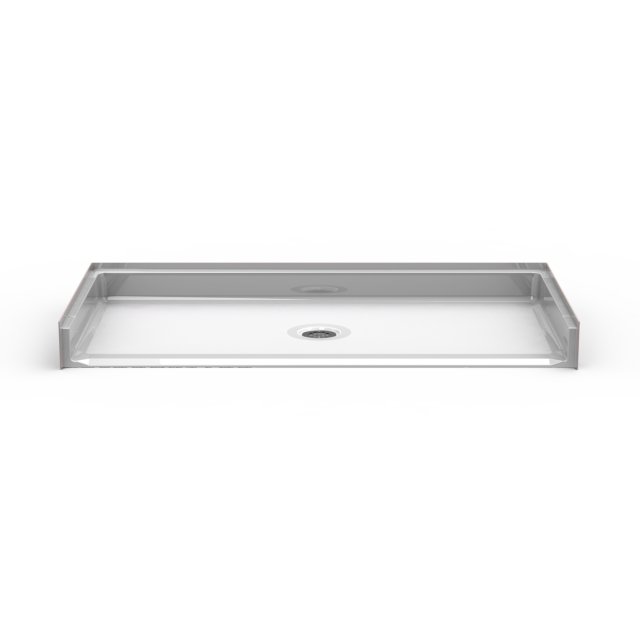
When you shop for a shower kit, pan and base almost always describe the same part: a one-piece, molded floor with the slope and drain opening built in. Our own shower pans page uses the words interchangeably for that reason. The confusion starts when you talk to a tile contractor, read a plumbing code, or compare a molded base against a quote for a tiled floor. In those conversations, “pan” can mean something you never see.
Three different products that all get called a pan
1. A molded, finished base
This is the floor of a shower kit. It is factory-made from gelcoated fiberglass, acrylic, solid surface or a composite, with the slope, the drain hole and usually a flange around the walls molded in. You set it, connect the drain and finish the walls to it. Its top surface is the surface you stand on, so the slip texture and finish are part of the product. Our materials comparison covers how each surface behaves.
2. A tile-ready base
Some systems sell a pre-sloped core, often foam or a composite, that replaces the sloped mortar bed under a tiled floor. You still tile the floor and waterproof it to the system maker’s instructions. It saves building a slope by hand, but it is not a finished floor and it is not what arrives in a shower kit.
3. A site-built pan
In a traditional tiled shower, the “pan” is a waterproof liner laid over a sloped base, with a mortar bed on top and tile over that. The International Residential Code lists acceptable liner materials, including plastic sheet meeting ASTM D4068 or ASTM D4551 and sheet lead or copper (IRC P2709, shower receptors). The finished tile floor hides all of it, which is why a failed liner usually shows up as a stain on the ceiling below rather than in the shower itself.
What the code calls it
Model plumbing codes call the floor of a shower a shower receptor, and they cover both factory-made receptors and ones built on site. For a curbed receptor, the IRC says the finished curb threshold must be at least one inch below the sides and back, and the receptor must be between 2 and 9 inches deep measured from the top of the curb to the top of the drain (P2709.1). Low-threshold and accessible designs are handled differently in many jurisdictions, so if you are buying a barrier-free base, ask your building department how it treats them before you order.
Molded base, tile-ready base or site-built pan: side by side
| Molded base | Tile-ready base | Site-built pan | |
|---|---|---|---|
| What you stand on | The base itself | Tile you install | Tile you install |
| Where the waterproofing is | In the molded shell | Membrane added on site | Liner under the mortar bed |
| Slope | Molded in | Molded in | Built by hand |
| Grout on the floor | None | Yes | Yes |
| Custom shape | Stock sizes, or built to order | Cut to fit, within limits | Any shape |
| Typical failure | Poor bedding, flexing floor | Membrane seams, grout | Liner leaks, clogged weep holes |
What the different pans cost
Published national figures mostly describe ordinary curbed bases. HomeGuide puts a prefab shower pan at about $150 to $950 for the pan alone and about $500 to $1,550 installed, with fiberglass pans around $150 to $450 and acrylic around $200 to $620 (HomeGuide, shower pan cost). Angi lists fiberglass at $150 to $450 and acrylic at $200 to $600 (Angi, shower pan replacement cost). Low-threshold and barrier-free pans with deeper engineered slopes, trench drains or wheelchair-rated floors sit well above those ranges; ours run $1,490 to $2,100 before freight, as the cost page sets out. If you see a big gap between two quotes, check first whether you are comparing the same kind of pan.
Flanges: the detail that keeps water in
A molded base has a raised lip, the flange, along every side that meets a wall. The wall panels or the tile backer come down in front of that flange, so water running down the wall lands in the base instead of behind it. When you buy a pan on its own to pair with walls from elsewhere, check that the flange height and the wall system are compatible. When you buy a complete kit, the maker has already matched them, which is one of the main reasons we sell pan-and-wall systems together.
Questions to ask before you buy any pan
- Is this a finished floor, or a base meant to be tiled over?
- What is the threshold height, measured from the bathroom floor?
- Where is the drain, and what size and type of drain body does it take?
- Does it arrive pre-leveled, and what does the maker require underneath it: mortar, foam bedding or a flat subfloor?
- What weight is the floor rated for, if a wheelchair or a heavy shower chair will be used?
- Which wall systems is the flange designed to work with?
- Can I see the written warranty before I order? See our warranty page for why that matters.
Which one should you buy?
If you want a shower that is finished the day it goes in, with no grout on the floor, a molded base is the answer, and a matched kit is the safest version of it. If you are set on a tiled floor and are hiring a tile setter, a tile-ready base or a site-built pan is what they will quote. If your walls are sound and only the floor has failed, buying a molded pan on its own is usually the cheapest repair; the shower pans page lists every height and size we carry.
Sources
- UpCodes, IRC P2709 Shower receptors
- HomeGuide, cost to install or replace a shower pan
- Angi, shower pan replacement cost
Checked October 2026. Codes and published prices change; follow the links for current figures.
Is a shower pan the same as a shower base?
When you are buying a shower kit, usually yes: both words describe a molded, pre-sloped shower floor. In the tile trade, a shower pan can also mean the waterproof liner and mortar bed built on site under a tiled floor, so ask which one a quote means.
What is a shower receptor?
It is the term plumbing codes use for the floor of a shower, whether factory-made or built on site. The IRC covers shower receptors in section P2709, including curb and depth rules for curbed designs and acceptable liner materials.
Can I tile over a molded shower base?
No. A molded base is a finished floor with its own surface and slip texture. If you want a tiled floor, you need a tile-ready base or a site-built pan, installed and waterproofed to the system maker's instructions.
Why do barrier-free pans cost more than the pans at a home center?
Most published pan prices describe ordinary curbed fiberglass or acrylic bases. Low-threshold and barrier-free pans carry engineered slopes, trench or relocated drains and floors rated for wheelchairs, so they cost more. Compare like with like.
Get your quote
Tell us what is failing and we will price the right floor.
Send the opening size, the drain position and whether the walls are sound. If the pan is all you need, we will quote the pan on its own.
Rather just talk?
1-888-779-2284A real person answers, and they know the product. No call center, no script.

Best Shower Kit is run by Aging Safely Baths, a BBB Accredited Business fitting accessible bathrooms since 2012. Click the seal to read the profile. Quotes are free, in writing, and nobody will chase you for an answer.